 Billions upon billions of tiny selfless organisms make the ultimate sacrifice every day to bring humankind delicious and healthful things to eat and drink, ranging from bread to beer to whiskey to that pinnacle of the fermentative arts, yogurt. (And cheese, but as always, the cheese stands alone.) I tip my hat to them in gratitude. Your sacrifice is not in vain.
(For those of you in the UK who are wondering, whiskey is almost the same as whisky, only better.)
I’ve made lots of bread. I haven’t ever made beer myself. I’ve made sima, a Finnish midsummer drink similar to beer, and I’ve made some truly terrible mead which I then distilled into a really good honey-flavored moonshine-like concoction that I occasionally pull out and put into a cocktail. I have to say distillation is also something to be grateful for, and despite how it’s portrayed in movies, it’s pretty easy to do with common kitchenware, as long as you aren’t trying to produce industrial quantities of liquor. Which would be illegal, so don’t do that. I strongly advise against it. In fact, forget I said anything about it.
If you want to make your own yogurt, the very same yogurt I make to feed my incredible body and make it feel good, here’s how.
You’ll need:
- A half gallon of organic milk (I use 2%, sometimes whole milk. Steer clear of skim.)
- A starter culture (after the first batch, this will be your own culture. I started my first batch with a 7 oz container of Fage 2% plain Greek yogurt. Whatever you use, make sure it says it has an active culture. Unlike Iowa City.)
- A 3-quart pot with a lid
- An instant-read thermometer (I have a nice digital one that my friend Gayle gave me, but the analog kind works, too)
- 2 1-quart mason jars
- 1 8-oz mason jar
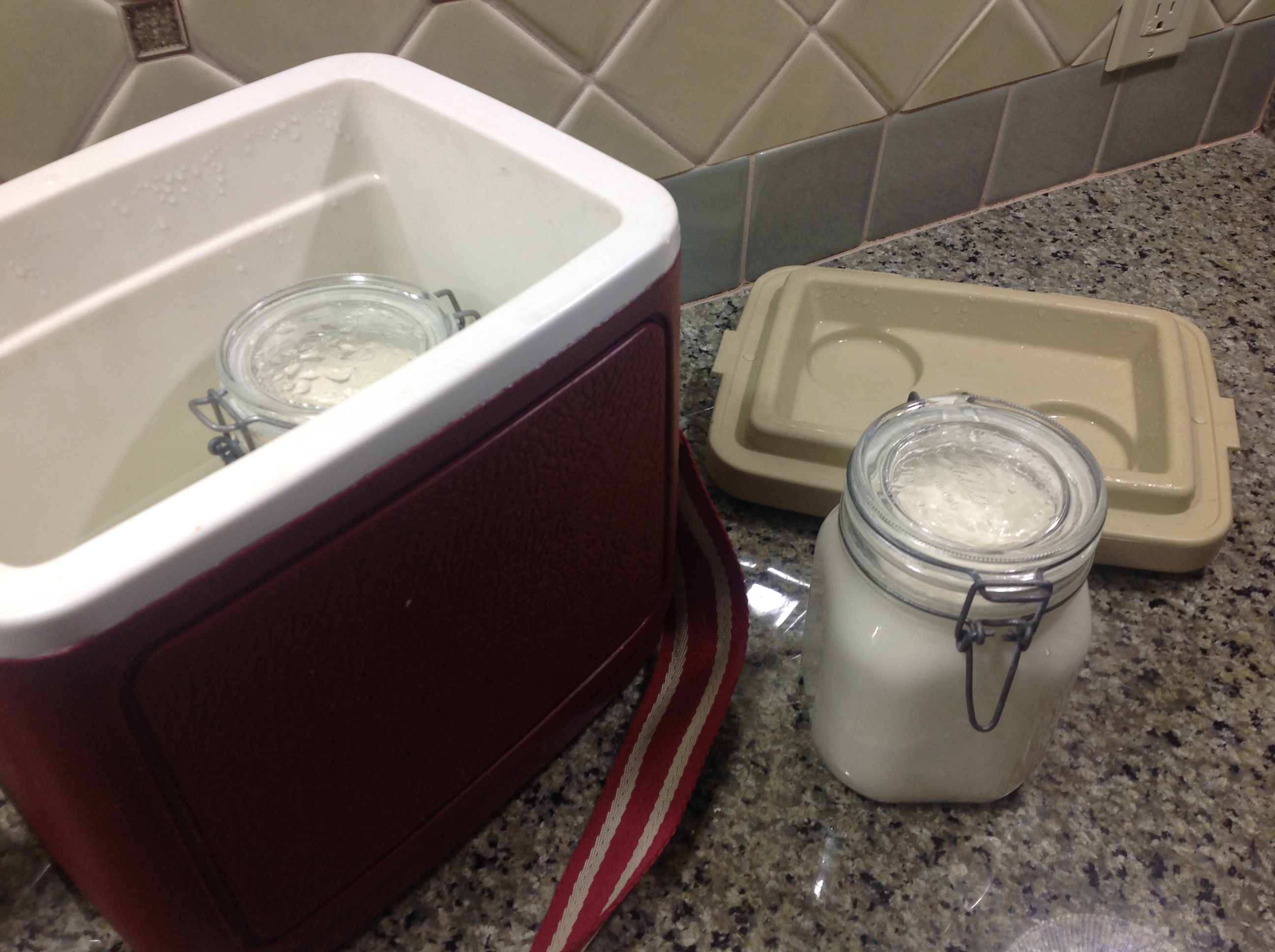
- A small cooler that the 2 1-quart jars will fit into (See the picture.)
- A tea kettle
- A spoon
Pour the milk into the pot, clip the thermometer onto it (and if it’s a nice digital one, set the alert to 180 degrees F), put the lid on as best you can with the thermometer in there, and set it on low heat to warm up to 180 degrees F.
While that’s heating, put the kettle on to boil.
When the kettle boils, use the water to scald out the mason jars and sterilize the spoon.
Fill the cooler with hot water (as hot as you can get it) from the tap and set it aside.
Stir the milk occasionally with the sterilized spoon.
Fill the kitchen sink to a depth about half that of the 3-quart pot with cold water (as cold as you can get) from the tap.
When the milk gets to 180 degrees F, take the pot off the heat and move it into the cold water in the sink. Stir with the spoon until it cools to 120 degrees F.
Move the pot back to the stove top, no heat, and stir your starter culture into it thoroughly.
Pour the mixture into the mason jars and close them.
Dump almost all the water out of the cooler. You want enough left to immerse the mason jars into without it coming up to the lips of the jars (otherwise as they cool they may suck water into the yogurt. Yuck.)
Test the water temperature in the cooler. It should be 120 degrees F. Adjust by adding hot or cold from the tap and bailing out the extra until you have the right amount at the right temperature. (Here’s a tip: you can pre-measure and mark the desired water level on the inside of the cooler with a pencil. Bet you wish I’d mentioned that up above.)
Immerse the mason jars into the 120 degree water, close the cooler, and wait 24 hours. (Tip: you can wait in another room.)
After 24 hours, you technically have yogurt, but DON’T spoon any of it out yet! For some reason, this breaks the yogurt and it doesn’t set up nicely or taste quite as yummy. Instead, move it to the refrigerator and wait another 24 hours.
Spoon 8 oz of the yogurt into the 8-oz mason jar (bet you forgot all about the 8-oz mason jar!) to be your next starter culture.
Now eat some yogurt! With granola, blueberries, sliced peaches, or whatever. Can also be mixed with horseradish, Coleman’s mustard, and cayenne to make an excellent sauce for roast beef. Or a dozen other uses you might not suspect if you haven’t made a habit of producing a half gallon of yogurt every week.
(Final tip: because I don’t have much patience for waiting to eat my yogurt while it cools down, I make a new batch as soon as I’m down to one 1-quart jar.)
I hope some of you are inspired by this to make some homemade yogurt. Let me know how it goes!